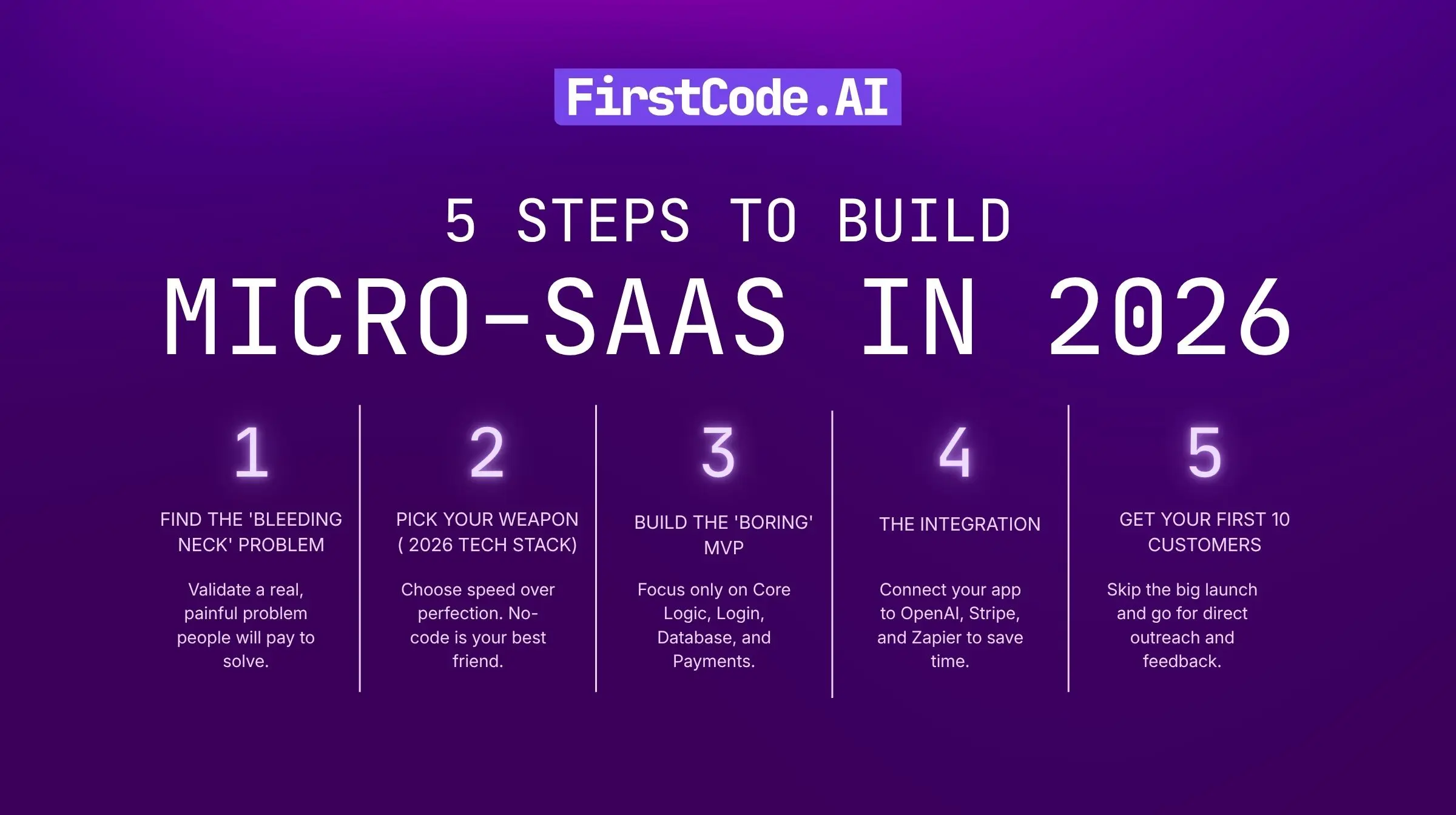
Key Takeaways (TL;DR)
What are we actually building here? Micro-SaaS development isn't about creating the next Facebook. It's about building a lean, hyper-focused tool that solves one specific, annoying problem for a niche group of people. Think: "One feature, done perfectly."
The "Stop Over-Engineering" Timeline: A real MVP should take between 48 hours and 4 weeks to build. If you've been "developing" for six months and haven't asked for a credit card yet, you're not building a business. you're indulging in a hobby.
The 2026 Founder's Toolbelt: The best no-code SaaS tools right now are Bubble (for complex web logic), FlutterFlow (if you need a mobile app), and Stripe (because if you aren't collecting money, it isn't a SaaS).
How to find a profitable niche SaaS idea: Stop looking for "cool" ideas. Look for "boring" industries. like local HVAC, legal compliance, or dental clinics. where people are still drowning in messy spreadsheets and 20-year-old legacy software.
So, you've got the idea. You've seen the 15 profitable Micro-SaaS ideas and picked your lane. Now comes the part where most founders get stuck: Execution.
Building a SaaS isn't just about writing code; it's about building a business that happens to run on code. Here is the actual, step-by-step framework we use at FirstCode.ai to take products from a "cool idea" to a "paid subscription."
Step 1: The "Bleeding Neck" Validation
Before you write a single line of code or drag a single element in Bubble, you need to prove someone will actually pay for this. We call this finding the "bleeding neck" problem. a pain point so sharp that the customer doesn't care if your UI is ugly, as long as it stops the bleeding.
- The Hustle: Forget fancy ads. Go to Reddit, niche Facebook groups, or the dark corners of industry-specific Discords. Don't ask, "Would you use this?" Ask, "How much is [Problem X] currently costing your business in time or money?"
- The Goal: If they tell you, "It's a nightmare, and I'm currently paying $500/mo for a clunky workaround that barely works," you've found a profitable niche SaaS opportunity. If they say, "That sounds neat," walk away. "Neat" doesn't pay the bills.
Step 2: Choose Your Weapon (The Tech Stack)
In 2026, the "Code vs. No-Code" debate is officially dead. The only metric that matters is speed-to-market. If you're spending three months arguing over JavaScript frameworks before you've even made your first $100, you're doing it wrong.
- The "Start Now" Path (No-Code): For 90% of MVP development, no-code tools like Bubble or FlutterFlow are the answer. They allow you to build, test, and iterate in days rather than months. You aren't "settling". you're being efficient. You can always rebuild in a custom framework once you hit $10k MRR. Until then, focus on the features that actually make money.
- The "Scale Fast" Path (Custom Code): If your app requires high-performance data processing or complex AI logic that no-code can't handle yet, then a custom stack like Next.js or Supabase is the way to go. But be warned: this path requires either serious dev skills or a dedicated technical partner.
- Founder's Advice: Don't build a custom engine if you're just trying to see if the car drives. Start with no-code. You can always rebuild in React once you're making $5k MRR.
Step 3: Build the "Boring" MVP (and ignore the rest)
A lot of founders confuse "Minimum Viable Product" with "a shitty version of my idea." It's not. It's the smallest set of features that actually delivers Value. If you're building a Micro-SaaS MVP, you need to be ruthless. You only need the "Big Four" pillars to start:
- The Core Logic: The one single thing that solves the problem (e.g., the AI dubbing engine or the tax calculator).
- Authentication: A way for people to sign up without you manually adding them to a database.
- The Database: A secure place where their data actually lives.
- The "Pay Me" Button: A Stripe integration so you can actually collect recurring revenue.
- Founder's Reality Check: Skip the "dark mode" toggle. Stop worrying about a "referral system" or a fancy logo. If your app doesn't solve the core problem, nobody is going to stay long enough to see your beautiful "About Us" page.
Step 4: The Integration "Gotchas" (The 80/20 Rule of Pain)
This is where 90% of SaaS development projects hit a wall. You'll spend two hours building the front end and twenty hours trying to get the "plumbing" to work.
- Don't Be a Hero with APIs: Unless you're a senior dev, don't try to write custom webhooks for everything. Use Make.com or Zapier to bridge the gap between your app and external services like OpenAI or Slack. It's not "cheating". it's shipping.
- Don't "Roll Your Own" Security: Even in an MVP, you can't play fast and loose with user data. Don't try to build a custom login system. Use managed services like Auth0 or Supabase Auth. It's safer, faster, and won't keep you awake at night worrying about a data breach.
Step 5: Forget Product Hunt. Go Find Your "First 10"
Everyone wants a "Big Launch" on Product Hunt with 1,000 upvotes. Here's the truth: upvotes don't pay the bills. Your first 10 customers should come from "hand-to-hand combat" and direct outreach.
- The "I Actually Built It" DM: Go back to every single person you talked to in Step 1. Send them a DM: "Hey, I actually built that tool we talked about. It solves [Problem X] and it's live. It's $19/mo. want to be one of my founding users?"
- The Feedback Loop: Those first 10 users are your most valuable asset. They will tell you exactly what's broken and what's missing. Listen to them, fix the bugs in real-time, and repeat until you have a product people actually recommend.
Frequently Asked Questions
How much does it cost to build a Micro-SaaS?
If you do it yourself using no-code, your overhead is roughly $50–$200/mo (hosting, domain, and API costs). If you hire a partner like FirstCode.ai, you're paying for speed and expertise, but you're saving months of trial and error.
How do I handle SaaS marketing on a $0 budget?
Content is your best friend. Write about the problem you solve (not the tool you built). Use the GEO strategies we talk about here: use clear headings, answer direct questions, and provide actual value that AI engines want to cite.
When should I quit my day job?
Not at $1k MRR. Wait until your Micro-SaaS is consistently covering your living expenses for at least three months. Remember, the "Micro" in Micro-SaaS means it's designed to be lean, not necessarily to replace a CEO's salary on day one.
Stop Dreaming, Start Building
The only difference between someone with a "good idea" and a real founder is Action. You have the plan. Now, you just have to choose how you want to get it done.
Path A: The DIY Route. Spend your weekends learning the tools, wrestling with APIs, and hacking it together yourself. It's a brutal but rewarding way to learn. If you're going this route, keep our Foundational Guide open in another tab. it'll help you avoid the most common landmines.
Path B: The Fast Track. If you have a brilliant idea but don't want to spend six months becoming a full-stack developer just to launch an MVP, let us handle the heavy lifting. At FirstCode.ai, we build the technical foundation so you can stay focused on the customers and the growth. We'll help you pick the right tools and ship a revenue-ready product in record time.
Too many great ideas die in a notebook because the tech feels too hard. Don't let that happen to you. Reach out today, and let's get your idea into the real world.
Email: contact@firstcode.dev
Phone: +1 (561) 501-0001